I am a DevOps Engineer and infrastructure nerd. I design and build on the cloud.
Suppressing Fires using Gas: An IoT Experiment
17 Mar 2018
•
Automation
An IoT experiment to create a gas based suppression system that can be used to extinguish fires inside water sensitive enclosures such as data centers. We make use of Arduino microcontrollers and several sensors to create this system.
The Design
A fully autonomous monitoring and suppression system that detects fire and extinguishes it using inert gases while also ensuring safety and avoiding danger at the same time. This system consists of the following functionalities:
The detection of fire using real-time data from fire and temperature sensors
The detection of personnel inside the data center using feedback from presence sensors
The release of gas to suppress the fire and continuous monitoring based on real-time feedback from fire and temperature sensors
The detection of any leftover gas or fire using feedback from the fire, temperature and gas sensors
The interfacing of the system using an HMI to allow monitoring and manual intervention in case of a unexpected event of malfunction.
The Architecture
The system consist of the following sensors and devices
Device
Purpose
MQ2 Gas sensor
Detection of inert gas
MQ2 temperature sensor
Detection of fire (measures temperature)
Magideal IR Infrared Fire sensor
Detection of fire (identifies fire)
L9110 fans
Exhaust and release of gas
Movement sensor
Detection of personnel
Arudino Nano
Controlling sensors (System Nano)
Arduino Nano
Reading system status (HMI Nano)
The Tools
The algorithm was designed using the Arduino IDE in Embedded C.
This was initial tested using Proteus which simulated the circuitboard.
We used these external libraries for the configuration of Modbus protocol which was used to help SCADA communicate with micro-controller.
We implemented the core system logic on the System Nano. Whereas, the SCADA
system using the Modbus system was implemented on the HMI Nano.
Using the HMI Nano, we continuously polled the pins of the System Nano to get the status of the devices and sensors.
Dishonourable mention: Arduino Olimexino is a failed product. It took a lot of troubleshooting attempts before we found out that the microcontroller was sending incorrect signals to the devices (fans changed direction of rotation randomly!)

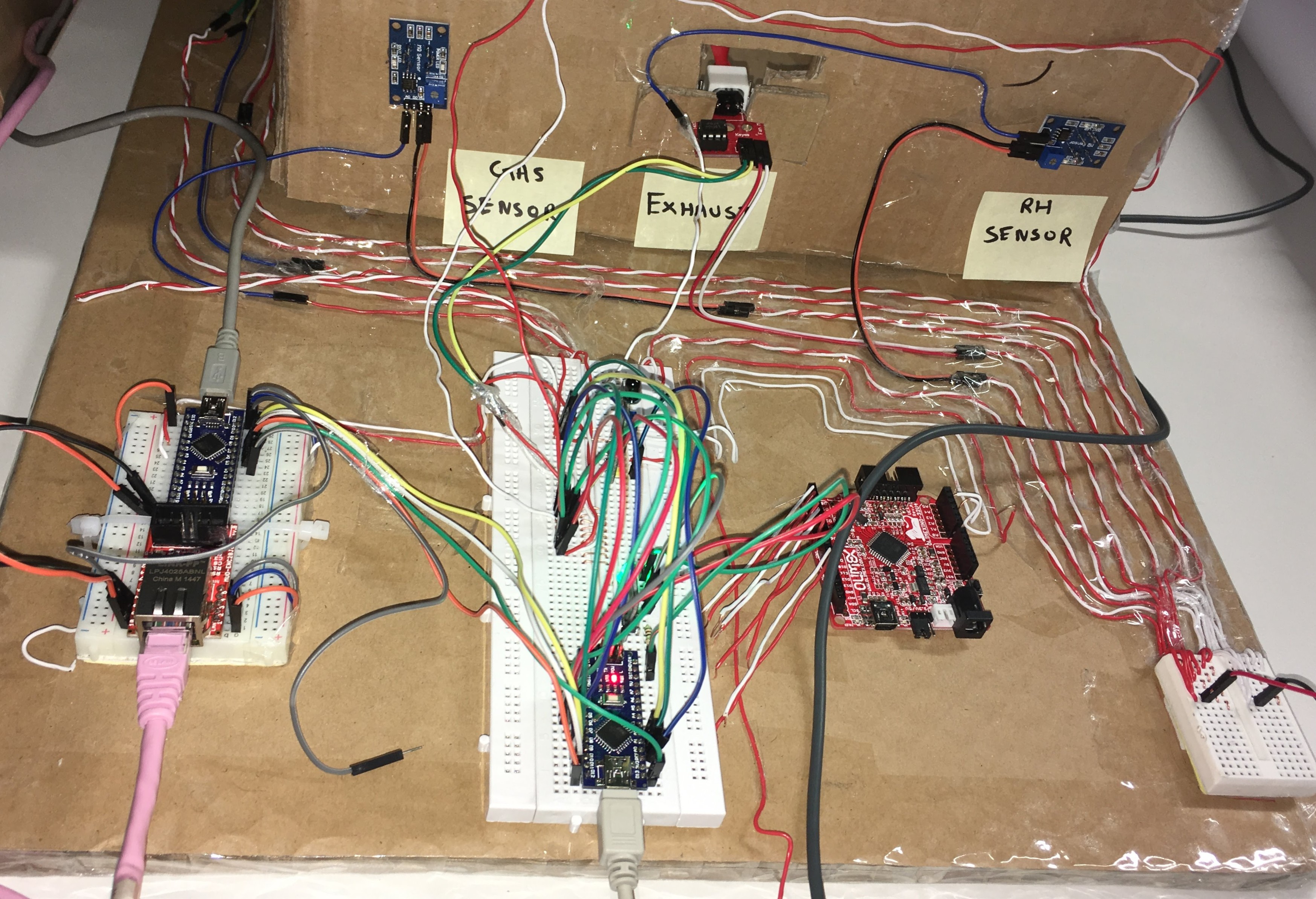 Starting from the left: Arduino Nano Jr, Arduino Nano Sr, Humble Breadboard, Village Idiot Arduino Olimexino (rightfully abandoned), Whole lotta sensors
Comments